

Happy 4th of July! No episode this week.
This newsletter is usually about the history of marketing. Today, it’s the reverse: I have a fun story about how I helped market history.
This week Google launched an ad that’s a whimsical tribute to America’s 250th birthday. It imagines what the founding fathers could have done with today's technology back in 1776, all told through Google products. Watch the ad here:
The initial concept was mine, and I made a scrappy 30-second prototype that won an internal competition at Google. Then a supremely talented team took it from prototype to reality and made it far better than I could have alone. I shared more of that story on my LinkedIn.
I keep my day job separate from this podcast hobby. But I thought you might enjoy hearing how this concept was shaped directly by my love of history and conversations I had on the show.
It started with ‘1984’
I covered Apple’s famous 1984 spot in conversations with Mark Tungate and Guy Kawasaki. I kept coming back to one point: that ad only works in 1984. You couldn't run it in 1983 or 1985. I think timing is an underrated part of advertising. So in the fall of 2025, I went looking for moments that would only exist in 2026. America's 250th birthday was sitting right there.
Ian Leslie and Collaboration
I developed this concept right after reading Ian Leslie’s excellent book John & Paul: A Love Story in Songs and interviewed Ian about The Beatles’ innovations in music marketing. Collaboration is the focus of the ad. Every scene shows the founders interacting with each other - over chat, email, meetings, hashing out ideas in a document. (The story of making the ad turned out to be a collaboration story too!)
Paul Feldwick: showmanship in advertising
Paul Feldwick wrote two excellent books: Why Does The Pedlar Sing? and Anatomy of Humbug. In my conversation with Paul he made the case that advertising is most effective when it’s entertaining. Marketers should bring a sense of showmanship to their work. This pushed me to pack as much entertainment per second into the ad as possible. My hope was that people would actually want to rewatch the ad, as opposed to skipping it entirely.
History can inspire creative ideas
The last influence is the most obvious: my love of history itself. Walter Isaacson’s Benjamin Franklin: An American Life might be my single favorite biography. You get midway through the book and he’s only 65, which tells you how much he packed into his later years.
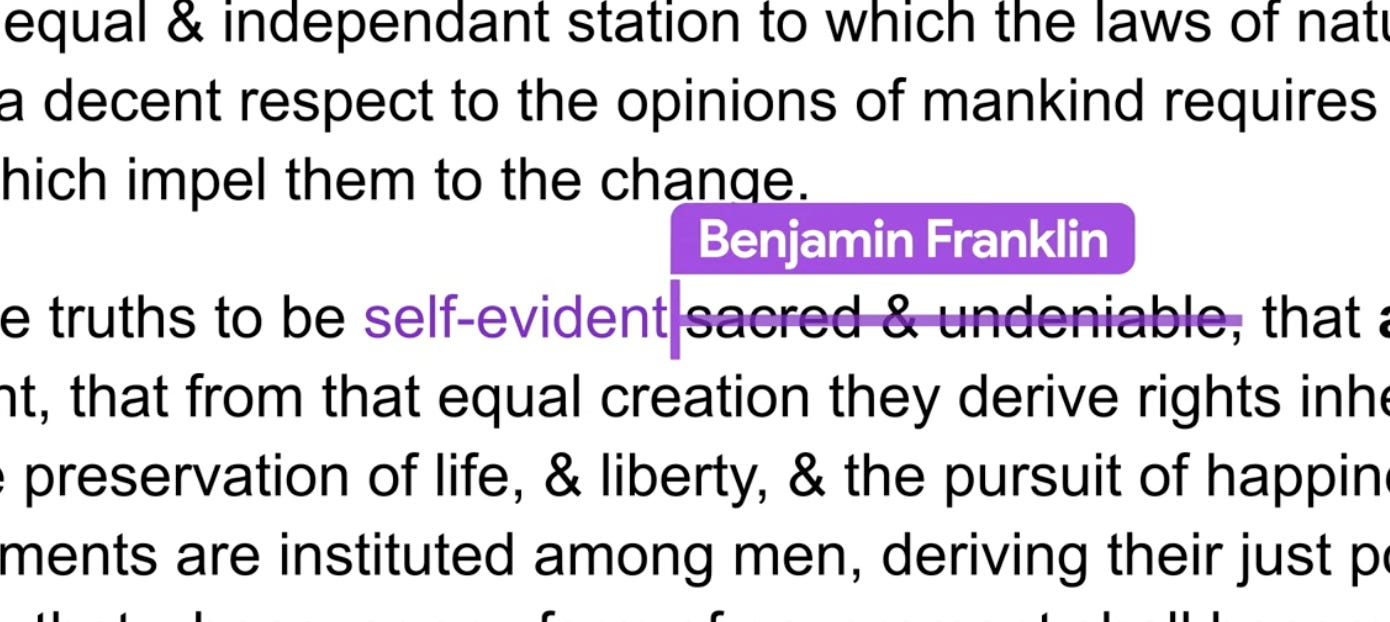
Franklin gets credit for what I consider the greatest copy edit of all time, changing “sacred & undeniable” to “self-evident” in the Declaration. (I should note the exact authorship of this edit is occasionally debated, but most attribute it to Franklin.)
I thought to myself, “Wouldn’t it be hilarious to see that as a suggested change in a Google Doc?” Then the rest of the ad wrote itself from that idea.
One more lineage worth naming: Google’s own advertising history. My all-time favorite Google ad is Parisian Love, the 2010 Super Bowl spot that told an entire love story through nothing but search queries.
I love this idea of telling a story through a product UI, so you’re entertaining people on one level and demonstrating the product benefits on another. I wouldn’t put the Declaration ad in the same league as Parisian Love, but I hope it fits in the long tradition of Google’s UI-led storytelling in ads.
Studying the past can make you better in the present
This podcast’s whole premise is that studying marketing’s past makes you better at practicing it in the present. This is the first time I’ve gotten to test that premise this directly. I’ll let you judge the results.
And if you watch it, I hope it earns a rewatch. Happy 250th.
-Andrew